
Month: October 2026
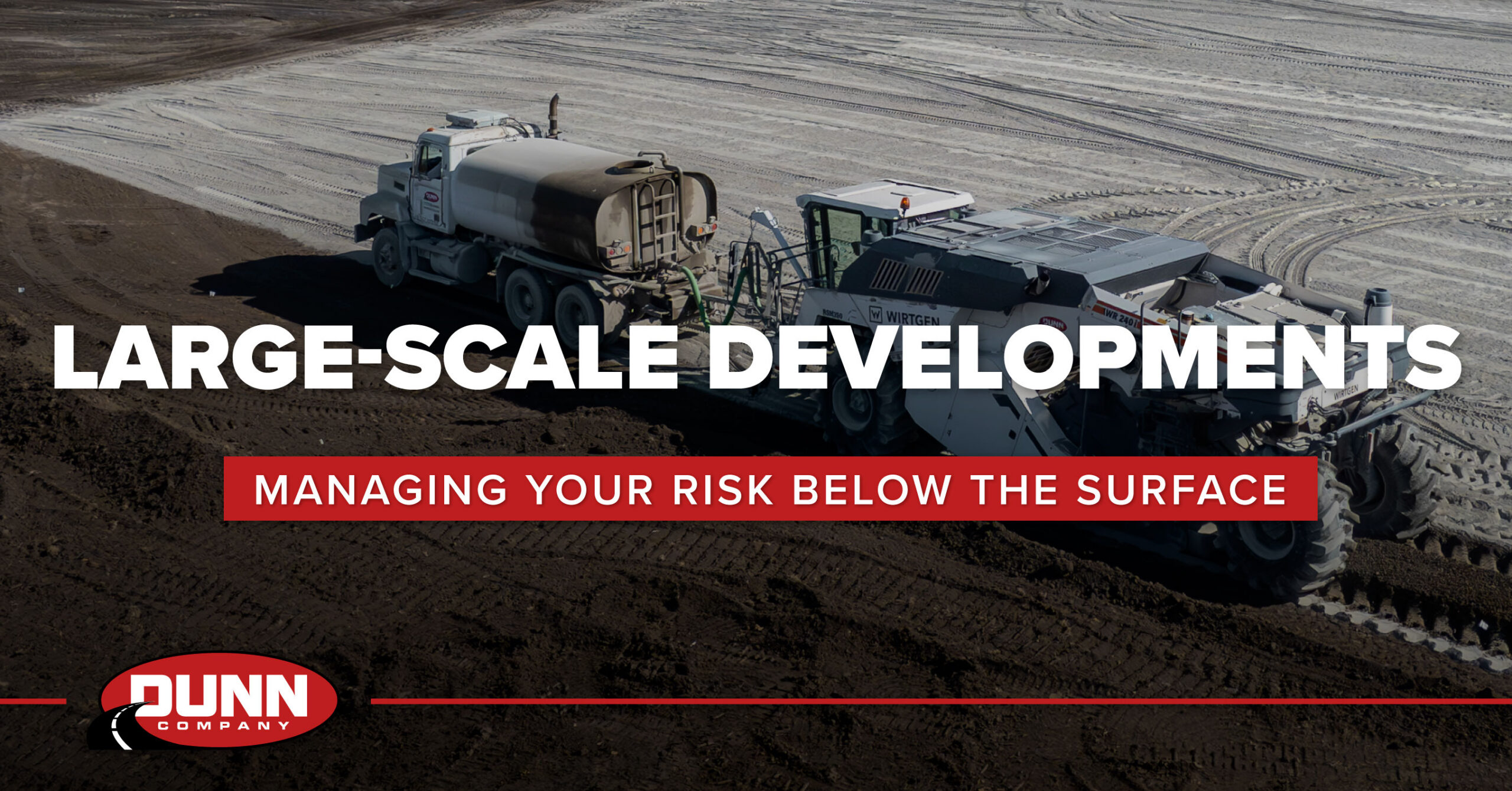
Managing Risk Below the Surface on Large-Scale Developments
Large-scale developments operate on tight schedules, significant budgets, and carefully coordinated timelines. Whether it’s a warehouse, distribution center, industrial facility, data center, renewable energy project, or major commercial development, dozens of moving parts must come together at the right time.
While many project risks are easy to see, some of the most consequential can be hidden below the surface.
Unstable soils, excessive moisture, insufficient bearing capacity, and changing site conditions can quickly affect access, productivity, material quantities, schedules, and costs. On projects spanning dozens or even hundreds of acres, relatively small problems can become significant when multiplied across the entire development.
Managing that risk starts with recognizing that ground conditions aren’t simply a sitework issue. They’re a project issue.
Small Problems Become Bigger at Scale
Scale changes everything.
A localized area of unsuitable soil on a small project may be relatively straightforward to address. Across a major development, inconsistent or poor soil conditions can affect thousands of square yards of working surface, roadways, parking areas, truck courts, staging areas, and future pavement.
The same is true for moisture. A weather event that creates a minor inconvenience on one site can significantly disrupt another when hundreds of workers, multiple contractors, and continuous equipment movement depend on reliable access.
These conditions can contribute to:
- Excessive undercutting
- Additional aggregate requirements
- Increased trucking
- Reduced equipment productivity
- Difficult construction access
- Weather-related downtime
- Unexpected material quantities
- Schedule disruptions
- Change orders
- Long-term pavement concerns
Individually, each may be manageable. Combined across a large development, they can have a much greater impact on the project.
Schedule Risk Starts Earlier Than You Think
On a large development, one delay rarely affects just one contractor.
Site preparation supports underground utilities. Utilities affect building construction. Construction access impacts material deliveries. Roadways and paved areas must eventually support both construction activity and permanent operations.
When poor ground conditions make portions of the site inaccessible or difficult to work on, the effects can move through the schedule.
Heavy equipment may struggle to operate efficiently. Trucks may be limited in where they can travel. Additional grading or material may be required. Work may need to stop while conditions improve.
That is why managing ground conditions early can have benefits far beyond the stabilization portion of the project. Creating reliable working platforms can help keep equipment, materials, and people moving when the schedule depends on it.
Weather Is More Than an Inconvenience
Weather will always be a variable in construction, but site conditions can determine how significantly it affects productivity.
Moisture-sensitive or weak soils can quickly deteriorate after rainfall, creating soft areas and limiting access for construction traffic. Repeated attempts to dry, grade, or replace unsuitable material can consume valuable time while other work waits.
Improving existing soils can help create more consistent working conditions and reduce the site’s vulnerability to changing weather.
The goal isn’t to eliminate weather risk. It’s to create a site that is better prepared to manage it.
Control Material and Transportation Risk
Traditional approaches to unsuitable soils can involve excavating existing material, hauling it off-site, importing aggregate or replacement material, placing it, and compacting it.
Sometimes that is the appropriate solution. But on a large development, the quantities involved can be substantial.
Every additional truckload introduces cost, scheduling, logistics, and availability considerations. When unexpected quantities increase across a large site, those impacts can add up quickly.
Soil stabilization can provide an alternative by improving existing materials in place. When site conditions and project requirements make stabilization appropriate, it can reduce the amount of material that needs to leave or enter the site while creating the strength required for continued construction.
The value isn’t simply using less material. It’s reducing another variable the project team has to manage.
Construction Access Is a Project-Wide Asset
Before a warehouse or industrial facility ever begins operations, its site may experience some of the heaviest traffic it will ever see.
Earthmoving equipment, concrete trucks, cranes, material deliveries, tractor-trailers, and contractors from multiple trades may depend on the same access routes and working areas.
Reliable access isn’t just convenient. It’s an asset that supports productivity across the project.
Stabilization can be used to develop working platforms and access areas capable of supporting construction traffic, helping crews move throughout the site and reducing interruptions caused by weak or inconsistent ground conditions.
When hundreds of people depend on the same site being workable, improving access can create benefits well beyond the initial site preparation.
Think Beyond Construction
Managing below-surface risk shouldn’t end when construction does.
The same ground will eventually support roadways, parking lots, loading areas, truck courts, equipment areas, and other infrastructure expected to perform for years or decades.
For warehouse, distribution, and industrial developments in particular, these surfaces may experience repeated heavy truck loads, turning movements, trailer staging, and concentrated loading.
If underlying conditions aren’t capable of adequately supporting those demands, problems can eventually appear at the surface through settlement, rutting, cracking, drainage issues, and premature pavement deterioration.
Addressing the conditions below the pavement during development helps protect the investment that will eventually be constructed above it.
Early Decisions Create More Options
One of the greatest advantages project teams have is time.
When potential soil challenges are identified early, developers, engineers, general contractors, and sitework teams have more opportunity to evaluate alternatives and determine the most appropriate solution.
Waiting until poor conditions are affecting production changes the conversation.
What could have been a planned construction strategy can become an immediate problem that needs to be solved while equipment, crews, and other contractors are waiting.
Early collaboration allows project teams to evaluate soil conditions, project requirements, anticipated loading, construction sequencing, and potential stabilization strategies before those conditions begin affecting the schedule.
The earlier risk is identified, the more options the project team has to manage it.
Stabilization Is a Risk Management Tool
Soil stabilization is ultimately about improving the engineering properties of existing soils. But on a large-scale development, its value can extend much further.
It can be part of a broader strategy to:
- Create more predictable working conditions
- Improve construction access
- Support heavy equipment and truck traffic
- Reduce reliance on imported materials
- Minimize excessive undercutting
- Reduce weather-related disruption
- Protect construction schedules
- Support long-term pavement performance
That makes stabilization more than another step in site preparation.
Used appropriately, it becomes a tool for creating greater certainty across the project.
Building Greater Certainty Into Large-Scale Development
No major construction project is without risk. The objective isn’t to eliminate every unknown; it’s to identify the variables that can be controlled and manage them before they become larger problems.
Ground conditions are one of those variables.
At Dunn Company, we work alongside developers, engineers, general contractors, and project teams to evaluate challenging site conditions and develop stabilization solutions around the needs of the project. From warehouses and industrial facilities to data centers, renewable energy projects, and other large-scale developments, our focus is on helping project teams create reliable conditions that support both construction and long-term performance.
When millions of dollars, multiple contractors, and critical schedules depend on the site beneath them, what happens below the surface deserves attention early.
Because managing risk before construction moves forward is always better than managing problems after they appear.
If you’re planning a large-scale development or facing challenging soil conditions, contact Dunn Company to discuss how stabilization can help reduce uncertainty and keep your project moving.
Frequently Asked Questions
Why are soil conditions a risk on large development projects?
Weak, unstable, or moisture-sensitive soils can affect construction access, equipment productivity, material requirements, schedules, and the long-term performance of pavement and infrastructure. On a large site, these impacts can become significant when repeated across many acres.
How can soil stabilization reduce project risk?
Stabilization improves existing soil conditions to create stronger, more reliable working surfaces. Depending on the project, this can help improve access, reduce excessive undercutting and imported material requirements, minimize weather-related disruption, and support long-term infrastructure performance.
When should soil stabilization be considered?
Potential stabilization needs should be evaluated as early as possible during planning and site development. Early evaluation gives project teams more time to understand conditions, compare alternatives, coordinate construction sequencing, and select the appropriate solution.
What types of large developments can benefit from stabilization?
Warehouses, distribution centers, industrial facilities, data centers, renewable energy developments, large commercial sites, and other projects involving extensive pavement or heavy construction traffic may benefit from stabilization when site conditions require it.
Can stabilization help keep construction on schedule?
When poor ground conditions are affecting access or productivity, stabilization can help create more reliable working platforms for equipment and construction traffic. This can reduce one source of uncertainty and help project teams maintain progress through challenging site conditions.
Stay Connected
For more information and to stay up to date on projects, industry information, and construction methods, follow Dunn Company online on Facebook, Instagram, YouTube, and LinkedIn.

How Much Does an Asphalt Driveway Cost?
When homeowners begin planning a new asphalt driveway, one of the first questions is usually simple: How much is this going to cost?
It’s an important question, but it may not be the most important one.
An asphalt driveway is a long-term investment in your property, and the price of the project depends on much more than the amount of asphalt you can see when the job is finished. Size, existing conditions, excavation, base preparation, drainage, pavement thickness, accessibility, and the amount of work required to properly construct the driveway can all influence the final cost.
That’s also why two estimates for what appears to be the same driveway can be very different.
At Dunn Company, our focus is on providing homeowners with a proper solution to fit their needs.
You’re Not Just Paying for Asphalt
When comparing driveway estimates, it can be tempting to look immediately at the number at the bottom of the page.
But are you actually comparing the same project?
A lower estimate may include a different amount of excavation, less base preparation, a different pavement thickness, or fewer steps to address existing conditions. Those differences aren’t always obvious once the finished asphalt is installed, but they can have a major impact on how the driveway performs.
The Illinois Asphalt Pavement Association emphasizes the importance of a stable, thoroughly compacted subgrade and proper pavement or aggregate-base construction.
The real value of a driveway isn’t determined on installation day. It’s determined by how well it continues to perform years later.
Proper Preparation Makes the Difference
One of the most important parts of a new driveway is also the part you’ll never see again once the project is finished.
Before paving begins, the existing conditions need to be evaluated. Is the underlying material stable? Are there soft areas? Does material need to be removed or replaced? Is the driveway properly graded? Where will water go?
The answers help determine what preparation is necessary before asphalt should ever be placed.
A properly prepared and compacted foundation helps distribute vehicle loads and provides stable support for the pavement above. When that foundation isn’t adequate, settlement, cracking, rutting, and other failures can develop regardless of how good the surface initially looks.
Dunn’s approach begins by evaluating the individual property and developing the pavement solution around its actual conditions and intended use.
Asphalt Thickness Matters
Not every asphalt driveway should be constructed exactly the same way.
The appropriate pavement section depends on the conditions underneath it and how the driveway will be used. A residential driveway primarily serving passenger vehicles may have different requirements than one regularly supporting trailers, RVs, delivery vehicles, or other heavier loads.
Just as importantly, homeowners should understand whether the thickness stated in an estimate represents asphalt before or after compaction.
Proper pavement construction is based on finished, compacted thickness. Compaction is critical because it creates the density necessary for the pavement to properly support traffic and perform as designed.
Saving money by reducing material or placing an inadequate pavement section can make an estimate look attractive today while potentially costing considerably more over the life of the driveway.
Don’t Overlook Drainage
Water can be one of the greatest threats to pavement performance, particularly through Central Illinois’ changing seasons.
That’s why drainage should be considered as part of the driveway—not as an afterthought.
Proper grading helps move water away from the pavement and prevents it from collecting where it can infiltrate and weaken the supporting materials. Existing drainage patterns, transitions, surrounding landscaping, and the relationship between the driveway and the home should all be considered before construction begins.
Dunn evaluates drainage and water flow as part of its driveway planning because even quality asphalt can experience premature problems when the structure beneath it is compromised by water.
Proper Installation Requires Experience and Care
Once paving begins, there is still plenty that can separate one contractor from another.
Asphalt needs to be placed consistently and compacted correctly while conditions allow the material to achieve the desired density. Temperature, weather, equipment, workmanship, joints, transitions, and edges can all affect the finished product.
The details matter.
Dunn Company brings decades of pavement experience, its own IDOT-certified asphalt plant, and extensive paving resources to residential projects throughout Central Illinois.
It’s the same commitment to pavement construction Dunn brings to roadways, commercial properties, and major infrastructure projects across the midwest, applied to the driveway leading to your home.
The Cheapest Driveway Can Become the Most Expensive
Price absolutely matters when choosing a paving contractor. But value and price aren’t necessarily the same thing.
Saving money upfront loses its advantage if a driveway requires premature repairs or replacement because important construction steps were skipped.
A properly constructed driveway represents an investment in:
- Appropriate site and base preparation
- Proper grading and drainage
- The right pavement thickness for the application
- Quality asphalt materials
- Proper placement and compaction
- Experienced crews and equipment
- Attention to transitions and edges
- Guidance on caring for the finished pavement
Those aren’t extras. They’re part of constructing pavement with long-term performance in mind.
Compare the Project, Not Just the Price
When you’re gathering estimates, ask questions.
What preparation is included? What happens if unsuitable base conditions are discovered? How will drainage be addressed? What pavement thickness is being proposed? Is that measurement before or after compaction? What materials will be used?
A reputable contractor should be able to explain what they’re recommending and why.
The goal shouldn’t necessarily be finding the cheapest asphalt driveway. It should be finding the best solution for your property and investment.
Searching for a Driveway Asphalt Contractor Near Me?
If you’ve reached the point where you’re searching online for a “driveway asphalt contractor near me,” don’t choose based on proximity or price alone.
Look for a local contractor with the experience, equipment, resources, and proven processes to properly evaluate and construct your driveway.
Dunn Company has called Central Illinois home since 1939 and provides residential pavement solutions backed by the same commitment to long-term value that defines our larger paving and infrastructure projects. Dunn continues to strengthen its commitment to driveway and parking lot customers throughout Macon County and the surrounding area.
So, when your search for an asphalt driveway contractor near you brings you to Dunn Company, know that our goal isn’t simply to give you the lowest number. It’s to give you confidence in what you’re investing in.
Invest in the Driveway, Not Just the Asphalt
Your driveway should look great when it’s finished. More importantly, it should be constructed to continue performing long after the paving equipment leaves your property.
At Dunn Company, we believe quality comes from doing the important things correctly, from evaluating the existing conditions and preparing the foundation to placing the proper pavement section and paying attention to the final details.
While you may find a cheaper estimate. Our goal is to provide a better long-term value.
If you’re considering a new asphalt driveway, contact Dunn Company to schedule a consultation and learn what the right paving solution looks like for your property.
Frequently Asked Questions
Why do asphalt driveway estimates vary so much?
Driveway costs depend on size, existing conditions, excavation, base preparation, drainage, pavement thickness, accessibility, and other project-specific requirements. Two estimates may appear to cover the same driveway while including very different scopes of work.
Should I choose the lowest asphalt driveway estimate?
Price should be considered, but homeowners should also compare what each contractor is actually providing. Proper preparation, drainage, pavement thickness, materials, and compaction can significantly affect long-term pavement performance.
How thick should an asphalt driveway be?
There isn’t one correct pavement section for every property. Thickness should account for the supporting base, site conditions, anticipated vehicle loads, and intended use. Dunn evaluates these factors when recommending a solution for a residential driveway.
Why is base preparation important for an asphalt driveway?
The base supports the asphalt and helps distribute vehicle loads. If it is unstable or inadequately compacted, the pavement above can settle, crack, rut, or deteriorate prematurely.
How do I find a quality asphalt driveway contractor near me?
Look beyond price. Ask potential contractors about their preparation process, compacted pavement thickness, drainage plan, materials, equipment, experience, and exactly what’s included in the estimate. For homeowners in Central Illinois searching for a local asphalt driveway contractor, Dunn Company provides residential paving backed by decades of pavement construction experience.
Stay Connected
For more information and to stay up to date on projects, industry information, and construction methods, follow Dunn Company online on Facebook, Instagram, YouTube, and LinkedIn.