
Month: August 2026

Why More Agencies Are Choosing Cold In-Place Recycling
Across Illinois and the Midwest, transportation agencies are facing a common challenge: how do you maintain and rehabilitate aging roadways while making the most of limited infrastructure budgets?
With thousands of miles of pavement requiring ongoing maintenance, agencies are looking beyond traditional rehabilitation methods and embracing solutions that maximize the value of every dollar invested. One method that continues to gain momentum is Cold In-Place Recycling (CIR).
By rehabilitating existing asphalt rather than removing and replacing it, CIR provides a cost-effective, sustainable, and efficient solution for many roadway projects, helping agencies extend pavement life while minimizing disruptions to the traveling public.
A Smarter Approach to Road Rehabilitation
Cold In-Place Recycling is a pavement rehabilitation process that mills the existing asphalt surface, processes the material on-site, blends it with a recycling agent, and places it back as a renewed pavement layer. A new asphalt surface is then applied to complete the roadway.
Unlike traditional reconstruction, CIR makes use of the pavement that’s already in place. This reduces the need for new aggregate and asphalt while preserving much of the existing roadway structure.
For many roadways experiencing surface deterioration, cracking, or oxidation, but still possessing a sound underlying foundation, CIR offers an excellent balance between pavement preservation and full reconstruction.
Maximizing Infrastructure Budgets
Every agency is tasked with managing more roadway miles than funding often allows.
Cold In-Place Recycling helps stretch available budgets by reducing material costs, limiting trucking requirements, and shortening construction schedules. Those efficiencies allow agencies to rehabilitate more lane miles within the same capital improvement program.
Rather than focusing solely on the initial project cost, many agencies evaluate the long-term value CIR provides through improved pavement performance and extended service life.
Keeping Roads Open and Communities Moving
Road construction inevitably impacts drivers, businesses, and nearby residents. One reason agencies continue to adopt CIR is its ability to reduce construction-related disruptions.
Because much of the existing material remains on-site throughout the process, projects often require fewer truckloads entering and leaving the work zone. This helps streamline operations while reducing traffic impacts and improving overall project efficiency.
For communities, that can mean shorter construction durations and a quicker return to normal traffic patterns.
Supporting Sustainable Infrastructure
Sustainability has become an increasingly important consideration in public infrastructure projects.
Cold In-Place Recycling aligns with those goals by reusing the existing asphalt pavement instead of sending it off-site for disposal. Reusing existing materials reduces the demand for virgin aggregates, decreases transportation requirements, and lowers overall material consumption.
The result is a rehabilitation method that not only benefits project budgets but also supports responsible resource management.
A Proven Solution for the Right Roadways
While CIR is not the answer for every project, it has become a proven rehabilitation strategy for many county highways, municipal streets, and rural roadways.
Roads that exhibit surface distress but maintain adequate structural support are often strong candidates for Cold In-Place Recycling. By restoring pavement before deterioration becomes more severe, agencies can delay costly reconstruction while improving ride quality and extending pavement performance.
Selecting the right rehabilitation strategy depends on pavement condition, traffic volumes, roadway function, and long-term maintenance goals. CIR is one of several tools available to help agencies make the most of their infrastructure investments.
Experience Matters
As more agencies throughout Illinois and the Midwest recognize the benefits of Cold In-Place Recycling, partnering with an experienced contractor becomes increasingly important.
Dunn Company has been at the forefront of innovative pavement rehabilitation, helping municipalities, counties, and transportation agencies evaluate when CIR is the right solution for their roadway network. From project planning through construction, our team delivers rehabilitation strategies that improve roadway performance, maximize infrastructure investments, and keep communities moving for years to come.
Frequently Asked Questions
What is Cold In-Place Recycling (CIR)?
Cold In-Place Recycling is a pavement rehabilitation process that reuses the existing asphalt pavement by milling, processing, and placing it back on the roadway before applying a new asphalt surface.
Why are more agencies choosing CIR?
Many agencies choose CIR because it helps extend pavement life, reduces material consumption, shortens construction time, and allows more roadway miles to be rehabilitated within available budgets.
Is CIR suitable for every roadway?
No. CIR is best suited for pavements with surface deterioration but a stable underlying structure. A pavement evaluation helps determine if it is the appropriate rehabilitation method.
What are the environmental benefits of CIR?
Because CIR reuses the existing pavement, it reduces the need for new materials, minimizes trucking, and supports more sustainable roadway construction practices.
How does Dunn Company help agencies with CIR projects?
Dunn Company works with municipalities, counties, and transportation agencies to evaluate roadway conditions and determine whether Cold In-Place Recycling is the right rehabilitation solution for each project.
Stay Connected
For more information and to stay up to date on projects, industry information, and construction methods, follow Dunn Company online on Facebook, Instagram, YouTube, and LinkedIn.
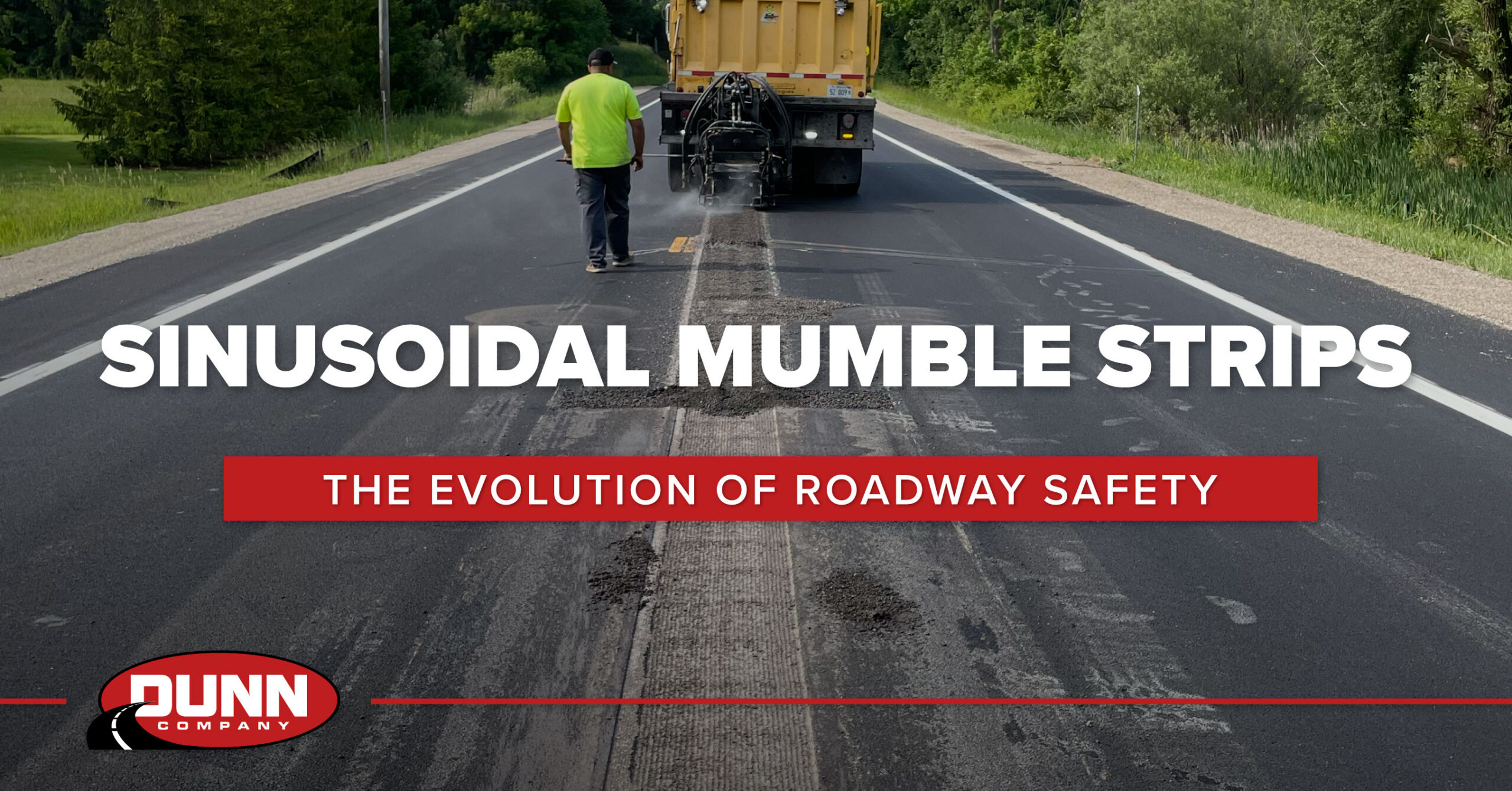
Rumble Strips vs. Sinusoidal Mumble Strips
The Evolution of Roadway Safety
For decades, rumble strips have been one of the most effective and economical roadway safety improvements available. By providing a combination of sound and vibration, they alert drivers who unintentionally drift from their lane, helping reduce some of the most severe crashes on our roadways.
Today, transportation agencies are evaluating a newer approach known as sinusoidal rumble strips, also known as “mumble strips.”
While the objective remains the same, the design offers an important advantage for roadways located near homes, businesses, and other noise-sensitive areas.
Why Rumble Strips Work
Lane departure crashes continue to be one of the leading causes of fatal and serious injury crashes. Whether caused by distraction, fatigue, or momentary inattention, drifting across a centerline or off the roadway can have devastating consequences.
Traditional rumble strips address this risk by milling grooves into the pavement that create a noticeable vibration and audible warning inside the vehicle when crossed. That immediate feedback gives drivers valuable time to recognize the lane departure and safely correct their course. Because of their proven effectiveness, rumble strips have become a standard safety treatment on many highways throughout the United States.
The Challenge: Roadside Noise
Although conventional rumble strips provide significant safety benefits, they also generate considerable exterior noise when vehicles travel across them.
Along rural highways this is rarely an issue. However, as communities expand and more roadways pass through residential neighborhoods, parks, schools, and commercial corridors, agencies must balance driver safety with quality of life for nearby residents.
That challenge has led engineers to explore alternative rumble strip profiles.
What Makes Sinusoidal Rumble Strips Different?
Unlike conventional rectangular grooves, sinusoidal rumble strips use a continuous wave-shaped profile milled into the pavement.
The smoother transition between peaks and valleys changes how vehicle tires interact with the pavement. The result is a warning that still produces meaningful vibration and sound inside the vehicle while significantly reducing the amount of noise projected into the surrounding community. Testing conducted by transportation agencies has shown exterior noise reductions of more than 6 decibels compared to conventional rumble strips, while maintaining comparable in-vehicle warning levels.
Where They Make Sense
Rather than replacing traditional rumble strips everywhere, sinusoidal rumble strips give transportation agencies another option when roadway safety and community considerations intersect.
Potential applications include:
- Residential corridors
- Urban and suburban roadways
- School zones
- Parks and recreational areas
- Roadways with nearby homes or businesses
For higher-speed rural highways where roadside noise is less of a concern, conventional rumble strips continue to be an effective and widely used solution.
A Growing Focus in Illinois
As transportation agencies continue to modernize roadway infrastructure, sinusoidal rumble strips represent another example of how engineering innovation can improve both safety and community compatibility.
Illinois has begun evaluating this technology as part of its ongoing commitment to safer transportation systems, joining other state DOTs that have already demonstrated the benefits of sinusoidal rumble strip designs.
Safety Is Still the Priority
Whether a project utilizes traditional rumble strips or sinusoidal rumble strips, the objective remains unchanged: helping drivers recognize unintended lane departures before a crash occurs.
As roadway design continues to evolve, innovations like sinusoidal rumble strips demonstrate that safety improvements don’t have to come at the expense of the communities they serve.
Leading the Way in Roadway Safety
As Illinois agencies and surrounding states continue to explore innovative safety solutions, Dunn Company is proud to be at the forefront of implementing sinusoidal rumble strips across the Midwest.
By combining proven construction expertise with emerging roadway technologies, we’re helping municipalities, counties, and transportation agencies improve driver safety while addressing the unique needs of the communities they serve.
If you’re planning a roadway improvement project and want to learn whether sinusoidal rumble strips are the right fit, our team is ready to help evaluate the best solution for your roadway.
Frequently Asked Questions
What are sinusoidal rumble strips?
Sinusoidal rumble strips are a newer type of rumble strip that uses a wave-shaped groove to alert drivers while reducing roadside noise compared to traditional rumble strips.
How are sinusoidal rumble strips different from traditional rumble strips?
Both improve driver awareness through vibration and sound, but sinusoidal rumble strips are designed to generate less noise outside the vehicle, making them a good option for noise-sensitive areas.
Where are sinusoidal rumble strips typically used?
They are commonly considered for roadways near residential neighborhoods, schools, parks, and other locations where reducing roadside noise is important.
Do sinusoidal rumble strips improve roadway safety?
Yes. Like traditional rumble strips, they help alert drivers who unintentionally leave their lane, reducing the risk of roadway departure crashes.
Can sinusoidal rumble strips be installed on existing roads?
Yes. They are typically milled into existing pavement as part of a resurfacing or roadway improvement project, making them an efficient safety enhancement.
Stay Connected
For more information and to stay up to date on projects, industry information, and construction methods, follow Dunn Company online on Facebook, Instagram, YouTube, and LinkedIn.